
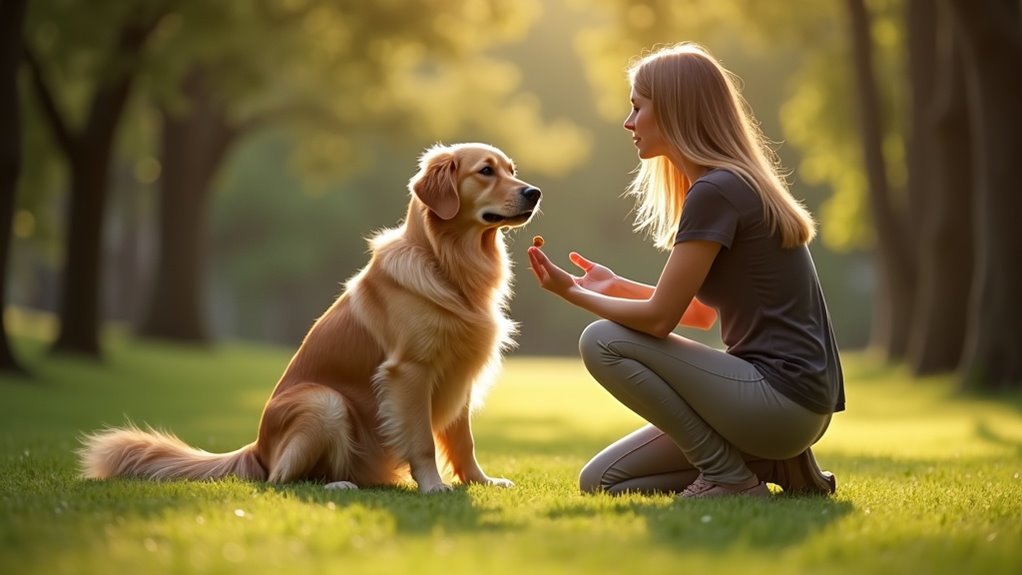
To teach your dog to “leave it,” start with two treats: a lower-value one under your hand and a higher-value one in your other hand. When your dog tries to get the lower treat, say “leave it.” Once they stop, reward them with the higher-value treat. Gradually place the lower-value treat on the ground and practice in various locations. This command enhances impulse control, ensuring your dog’s safety. Keep going to discover more effective training tips!
Key Takeaways
- Use two treats: a lower-value one under your hand and a higher-value treat in the other hand to start training.
- Cue “leave it” when your dog tries to access the lower-value treat and wait for them to stop.
- Reward your dog with the higher-value treat immediately after they ignore the lower-value treat.
- Gradually practice with the lower-value treat on the ground, reinforcing impulse control in various environments.
- Introduce real-world distractions and beloved toys to help your dog generalize the “leave it” command beyond food.
Understanding the “Leave It” Command
When you teach your dog the “leave it” command, you’re not just giving them a simple trick; you’re enhancing their impulse control and safety in various situations.
This command instructs your dog to ignore distractions, whether they’re objects or people, helping them focus on you instead.
Start teaching by placing a lower-value treat on a surface, covering it with your hand. When your dog stops trying to access it, reward your dog with a high-value treat.
Consistently practicing in different environments reinforces this behavior, creating a reliable response.
Step-by-Step Training Techniques
To effectively teach your dog the “leave it” command, you’ll want to follow a series of clear steps that build their understanding and impulse control.
Start with two treats: a lower-value one under your hand and a higher-value treat in your other hand. When your dog tries to access the lower-value treat, use the cue “leave it.” Wait until they stop, then reward them with the higher-value treat.
Gradually place the lower-value treat on the ground, covering it if they try to grab it. Consistently practice in various locations to help your dog learn to leave distractions behind.
Progressing to Real-World Scenarios
Now it’s time to take your dog’s training to the next level by introducing real-world distractions.
Start with low-value treats on the ground, using the “leave it” command to reinforce their impulse control.
As they master this, gradually incorporate other objects and distractions, ensuring consistent reinforcement for their success in various environments.
Real-World Hazards Training
As you progress with your dog’s training, incorporating real-world hazards becomes essential for reinforcing the “leave it” command. This helps your dog understand the significance of ignoring distractions in everyday situations.
Here are some tips:
- Start with low-value treats on the ground during walks.
- Use high-value treats to reward successful ignoring of temptations.
- Practice in diverse outdoor locations to build reliability.
- Introduce loved toys to expand the “leave it” command beyond food.
Gradual Distraction Introduction
When you begin introducing distractions during training, it’s important to gradually increase the challenge to help your dog adapt effectively.
Start with low-value treats placed out of reach, and as your dog masters the “leave it” command, introduce more exciting distractions. Use a leash to maintain control, ensuring your dog focuses on you.
Practice in various locations, like parks or streets, to enhance their reliability. Replace food distractions with beloved toys, generalizing the “leave it” command beyond treats alone.
Keep sessions short and engaging, turning training into a fun game that maintains your dog’s enthusiasm amid distractions.
Consistent Reinforcement Practices
To effectively reinforce the “leave it” command, you must practice in real-world scenarios where distractions are commonplace.
Use these strategies to enhance your training:
- Start with low-value items, gradually introducing higher-value distractions.
- Practice in various environments, like parks or busy streets, to increase reliability.
- Keep your dog on a leash to prevent access to distractions while training.
- Reward immediately with high-value treats for ignoring distractions.
Reinforcing the Command With Rewards
To reinforce the “leave it” command, you’ll need to focus on timing and the variety of rewards you use.
Reward your dog immediately when they disengage from an object, which strengthens the behavior you want to see.
Don’t forget to mix in jackpot rewards for outstanding performances to keep your dog motivated and engaged!
Timing of Rewards
While teaching your dog the “leave it” command, the timing of your rewards plays a critical role in their learning process.
You want to reinforce the desired behavior immediately when your dog disengages from the treat on the ground. Here are key points to remember:
- Use clicker training or verbal markers for clarity.
- Offer a high-value treat from your other hand as a reward.
- Maintain consistent timing across training sessions.
- Avoid delays in rewards to prevent confusion.
Variety of Reinforcements
Incorporating a variety of reinforcements not only makes training more enjoyable for your dog but also enhances their motivation to respond to the “leave it” command.
Use high-value treats from one hand to reward your dog for ignoring lower-value items. Mixing in their favorite toy or playtime as a reward can keep the experience engaging.
Reinforce good behavior immediately after your dog disengages, as timing is essential.
Jackpot Rewards Strategy
When your dog successfully ignores a tempting object, using a jackpot reward can elevate their motivation to comply with the “leave it” command. This strategy reinforces the behavior by offering a high-value treat that outshines the distraction.
- Timing’s essential—reward immediately as your dog finishes disengaging.
- Consistency helps solidify the “leave it” command.
- Higher rewards foster greater focus and engagement during training.
- Jackpot rewards make ignoring tempting items more appealing.
Generalization and Handling Errors
To effectively teach your dog the “leave it” command, generalization is key; it guarantees your pup understands the cue in various contexts and with different distractions.
To handle errors, step back if your dog lunges for an item, allowing them to succeed at the last successful level before advancing.
If your dog lunges for something, revert to the last success to help them progress effectively.
Monitor training sessions for errors to identify when to break behaviors into smaller steps, making it easier for your dog to grasp the concept.
Consistent reinforcement across diverse settings helps build reliability, ensuring your training is effective.
Remember to keep your dog engaged and focused for ideal learning.
Keeping Training Fun and Engaging
Keeping training fun and engaging is essential for maintaining your dog’s interest and enthusiasm. Here are some tips to enhance your sessions:
- Incorporate a variety of rewards like toys or extra playtime.
- Keep training sessions short, around 5-10 minutes, for better focus.
- Use interactive games, like the Up Down game, to promote fun learning.
- Practice in different locations with distractions to create positive experiences.






